智能体
x.com ·
@jerryjliu0
LlamaIndex 提出“Just-in-Time OCR”两段式文档处理模式
LlamaIndex 的 Jerry Liu 将当前 agent harness(如 Cowork、Codex、Grok)处理用户上传文档数据室的常见做法命名为“Just-in-Time OCR”:第一遍用免费/开源解析工具(如 Liteparse)低成本快速扫描上百份文档,第二遍用专用 OCR(如 LlamaParse)仅对需要精读的页面做高精度转写。作者称该模式在 10-100 份文档规模下效果良好,代价是成本与延迟,不能替代大规模离线索引与检索;并批评默认用 pypdf 加原生 VLM 的两遍方案既贵又缺乏准确性与 grounding。
AI推荐理由 LlamaIndex 创始人提出并命名“Just-in-Time OCR”两段式文档处理模式:先用免费 OSS 解析器(Liteparse)快速扫全量文档,再用专用 OCR(LlamaParse)按页号精读子集,并指出该模式适合 10-100 份文档、以成本与延迟换取精度,不适用于大规模离线索引。属于有具体方法、适用边界和工具指向的工程经验分享,但本质是自家产品推广,性能数字(如 32 秒)来自其博客,未在正文中独立验证。
72
浏览 426
点赞 4
评论 3
转发 0
正文
“Just-in-Time” OCR
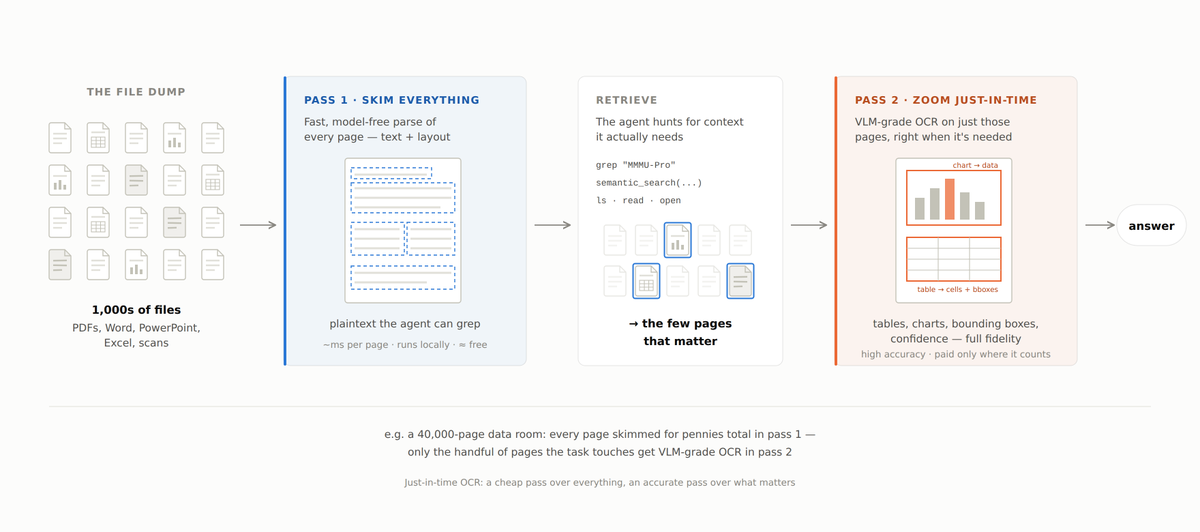
The latest agent harnesses (e.g. Cowork, Codex, Grok) do 2 passes of ad-hoc document processing when executing over a user-uploaded ‘data room’ of documents:
1️⃣ A fast and light pass using a free/OSS doc parsing tool, can be cheaply run over 100+ docs
2️⃣ A “just-in-time” pass using a dedicated OCR tool (like LlamaParse) that does more accurate transcription over a subset of pages.
This pattern is common enough that I wanted to give it a name: “Just-in-Time OCR”. It works surprisingly well over a small to medium batch of docs (e.g. 10-100 docs); it is accurate at the expense of cost and latency. It’s not a substitute for large-scale offline indexing and retrieval.
The ‘default’ approach for any frontier agent harness is to use an OSS tool like pypdf for the first pass and its native VLM (e.g. Fable 5.1) as the second pass. This is both expensive and lacks accuracy and grounding.
If you’re a builder looking to implement this type of harness of a document data room, you can try out our suite of tools:
- Liteparse as the first pass (the best/fastest OSS text parser)
- LlamaParse as the second pass (most Pareto-efficient, includes grounding)
Check out the blog post below! [llamaindex.ai/blog/just-in-t…](https://www.llamaindex.ai/blog/just-in-time-agentic-ocr)

LlamaIndex 🦙@llama\_index
just-in-time OCR is all the rage.
most pipelines parse every page before anyone asks a question. for an agent working through an ad-hoc data room, that's slow, expensive, and most of those pages never get read.
the better pattern is just-in-time OCR in two passes:
✅️ LiteParse (free, OSS, Rust, 50+ formats) does a fast layout-aware first pass: spatial text, bounding boxes, headings, tables, and a per-page complexity flag. a full data room in 32 seconds.
✅️ LlamaParse zooms in on only the pages that need it, by page number, and returns cell-level tables, bounding boxes, and confidence scores. the rest fills in the background.
pypdf and pdftotext can't do the first pass well. parsing everything up front can't do it cheaply. two passes gets you both.
full breakdown with numbers: [llamaindex.ai/blog/just-in-t…](https://www.llamaindex.ai/blog/just-in-time-agentic-ocr)

[🔗 View Quoted Tweet](https://x.com/llama_index/status/2099528648021745677)