智能体
x.com ·
@omarsar0
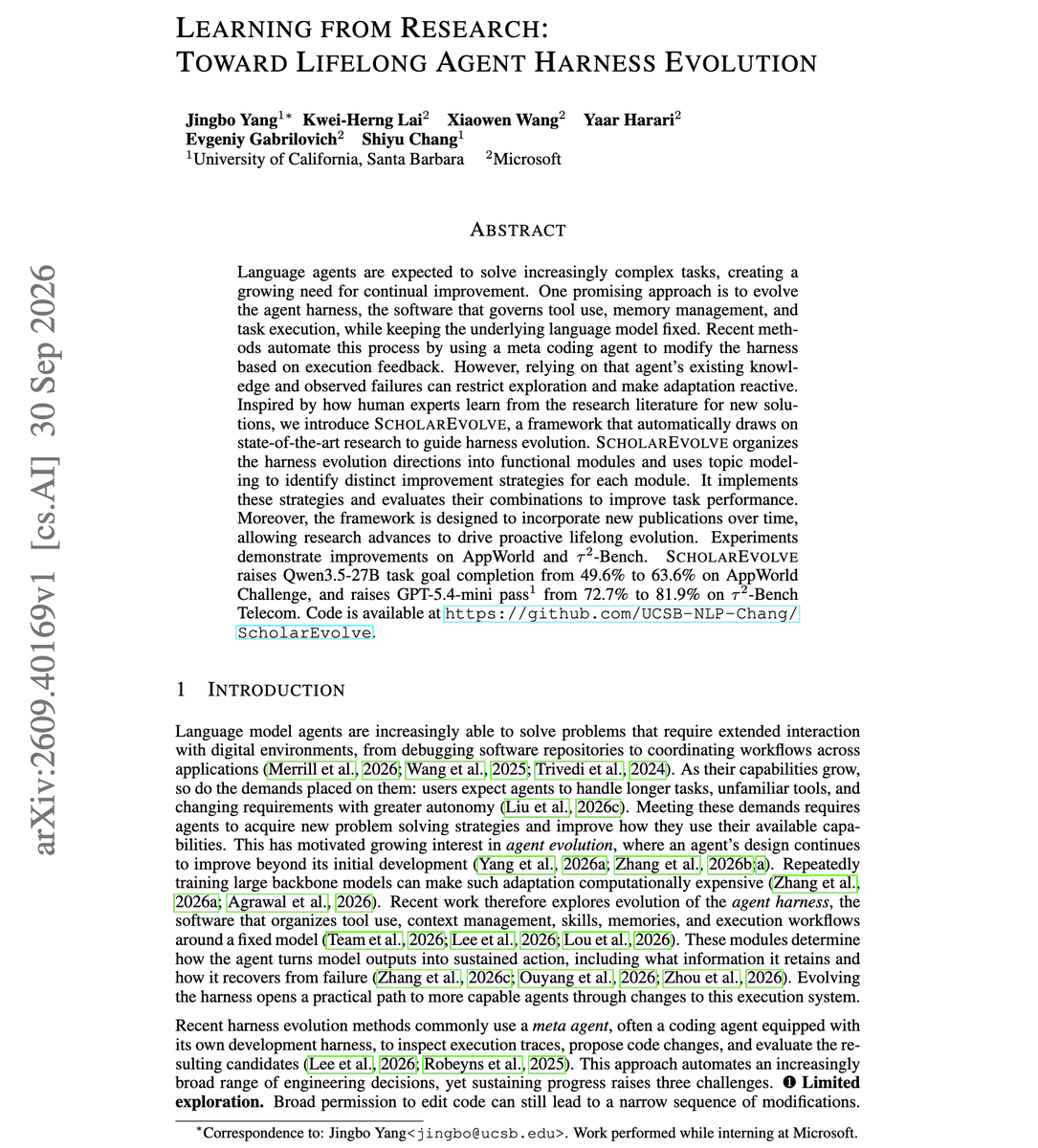
微软新论文提出 ScholarEvolve:用已发表研究演化 Agent harness
微软及合作者提出 ScholarEvolve,思路是依据已发表的 Agent 研究而非 Agent 自身失败日志来改进 harness:将 harness 拆分为工具使用、记忆管理和任务执行模块,对近期论文做主题建模以识别各模块的改进策略,再实现并测试组合,且可持续加入新论文。在模型固定的条件下,Qwen3.5-27B 在 AppWorld Challenge 的目标完成率从 49.6% 升至 63.6%,GPT-5.4-mini 在 Tau2-Bench Telecom 从 72.7% 升至 81.9%。
AI推荐理由 帖子介绍 Microsoft 及合作者的新论文 ScholarEvolve,给出具体方法(按工具使用、记忆管理、任务执行拆分 harness 模块,对近期论文做主题建模生成改进策略并组合测试)和可验证的基准数字(Qwen3.5-27B 在 AppWorld Challenge 从 49.6% 升至 63.6%,GPT-5.4-mini 在 Tau2-Bench Telecom 从 72.7% 升至 81.9%),并附 arXiv 链接。属研究者转述,事实明确、信息密度高;但为二手介绍,未独立验证,故质量分未给满分。
80
浏览 3,090
点赞 32
评论 12
转发 13
正文
New paper from Microsoft and colleagues on evolving agent harnesses.
It's a really cool idea to evolve a harness from published research. Something I have also been testing for the past couple of months.
ScholarEvolve proposes harness changes based on published agent research rather than the agent's own failure logs.
It splits the harness into modules for tool use, memory management, and task execution.
It runs topic modeling over recent papers to identify distinct improvement strategies for each module, then implements and tests combinations.
New papers can be added over time.
With the model held fixed, Qwen3.5-27B goal completion on AppWorld Challenge rises from 49.6% to 63.6%, and GPT-5.4-mini on Tau2-Bench Telecom rises from 72.7% to 81.9%.
Paper: [arxiv.org/abs/2609.40169](https://arxiv.org/abs/2609.40169)
Chat with Paper: [academy.dair.ai/papers/learnin…](https://academy.dair.ai/papers/learning-from-research-toward-lifelong-agent-harness-evolution-2609.40169)