智能体
x.com ·
@omarsar0
MIT CSAIL 论文提出极简 agent 框架 JAZ:仅一个 invoke 原语
该帖介绍一篇据称来自 MIT CSAIL 的论文,提出极简 agent 框架 JAZ,只保留 invoke 一个原语:LLM 编写代码、可递归调用 invoke,并把全部输入与历史视为代码环境中的变量。帖子称在仅用提示、无独立记忆系统的情况下,JAZ 在 StuLife 的 recall 密集部分以一半成本超过 Letta(MemGPT) 8%,在 AppWorld 上以更低成本超过自改进方法 ACE 4%;记忆与自改进不再作为独立子系统,而是 agent 在循环内编写的代码,约束与监控由 hooks 处理。帖中附有 arXiv 链接,但对比数据为转述,尚待独立验证。
AI推荐理由 该帖介绍一篇据称来自 MIT CSAIL 的论文,提出极简 agent 框架 JAZ:只有 invoke 一个原语,LLM 写代码并可递归调用 invoke,把输入与历史视为代码环境中的变量。帖中给出具体对比数字:在 StuLife 的 recall 密集部分以一半成本超过 Letta(MemGPT) 8%,在 AppWorld 上以更低成本超过自改进方法 ACE 4%,并附 arXiv 链接。信息密度高、指向可查证论文,对 agent 架构与记忆/自改进设计有实际参考价值;但数据来自帖子转述,尚未经独立验证,'有效且有前景'属作者评价。
78
浏览 2,636
点赞 27
评论 13
转发 4
正文
Keep your agent harness minimal, folks.
This paper from MIT CSAIL shows why.
(bookmark it)
While being very minimal it looks effective and promising for building self-improving agents.
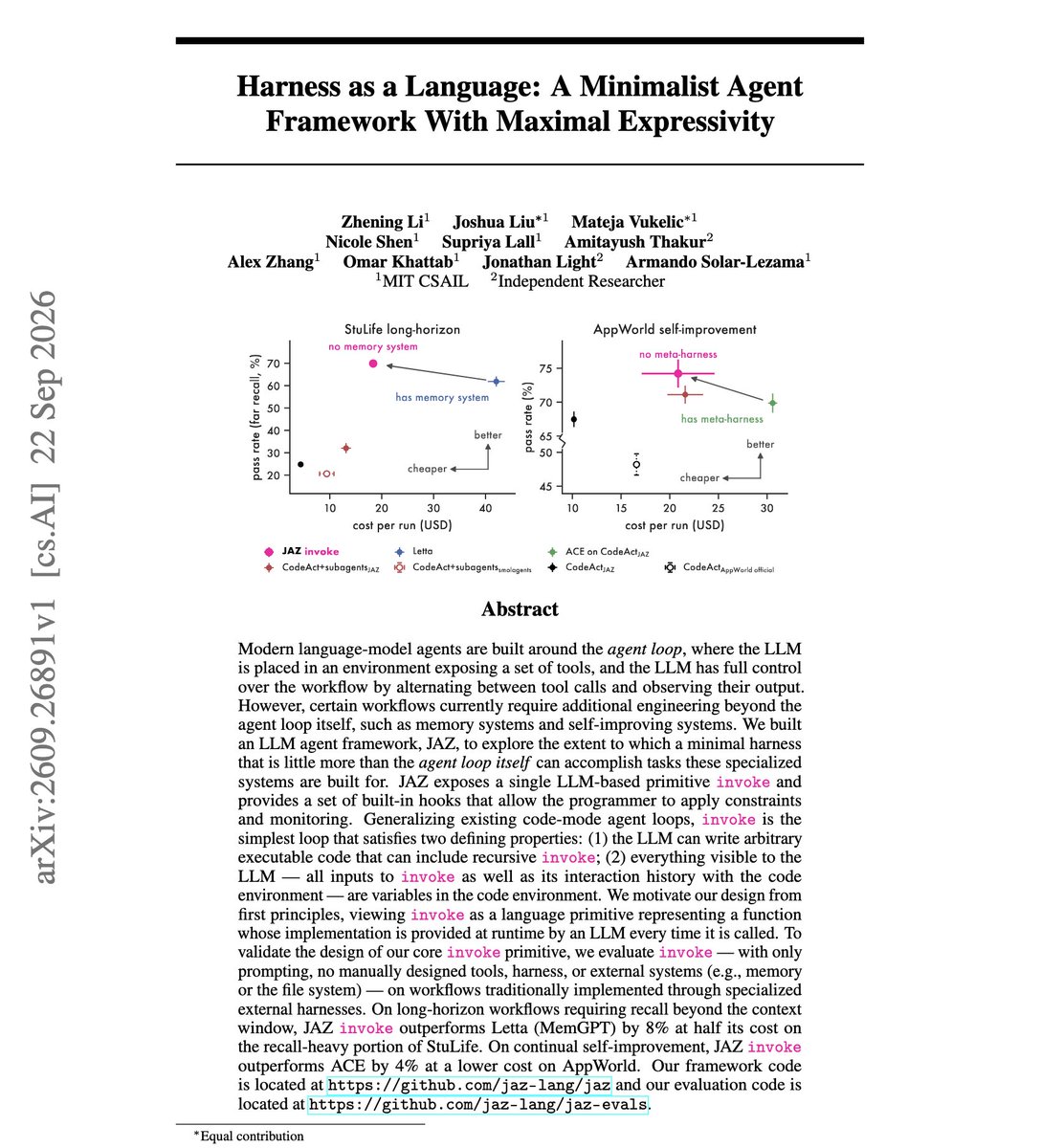
They present JAZ, an agent framework with one primitive, invoke. The LLM writes code, can call invoke recursively, and sees all of its inputs and history as variables in the code environment.
With prompting only and no memory system, it beats Letta (MemGPT) by 8% at half the cost on the recall-heavy part of StuLife.
On AppWorld it beats ACE, a self-improvement method, by 4% at lower cost.
Memory and self-improvement are usually built as separate subsystems. Here both are code the agent writes inside the loop, and hooks handle the constraints and monitoring you want to enforce.
Paper: [arxiv.org/abs/2609.26891](https://arxiv.org/abs/2609.26891)
Explore Paper: [academy.dair.ai/papers/harness…](https://academy.dair.ai/papers/harness-as-a-language-a-minimalist-agent-framework-with-maximal-expressivity-2609.26891)