智能体
x.com ·
@omarsar0
UT Austin 研究:LLM Agent 上下文压缩可能反而拖慢运行
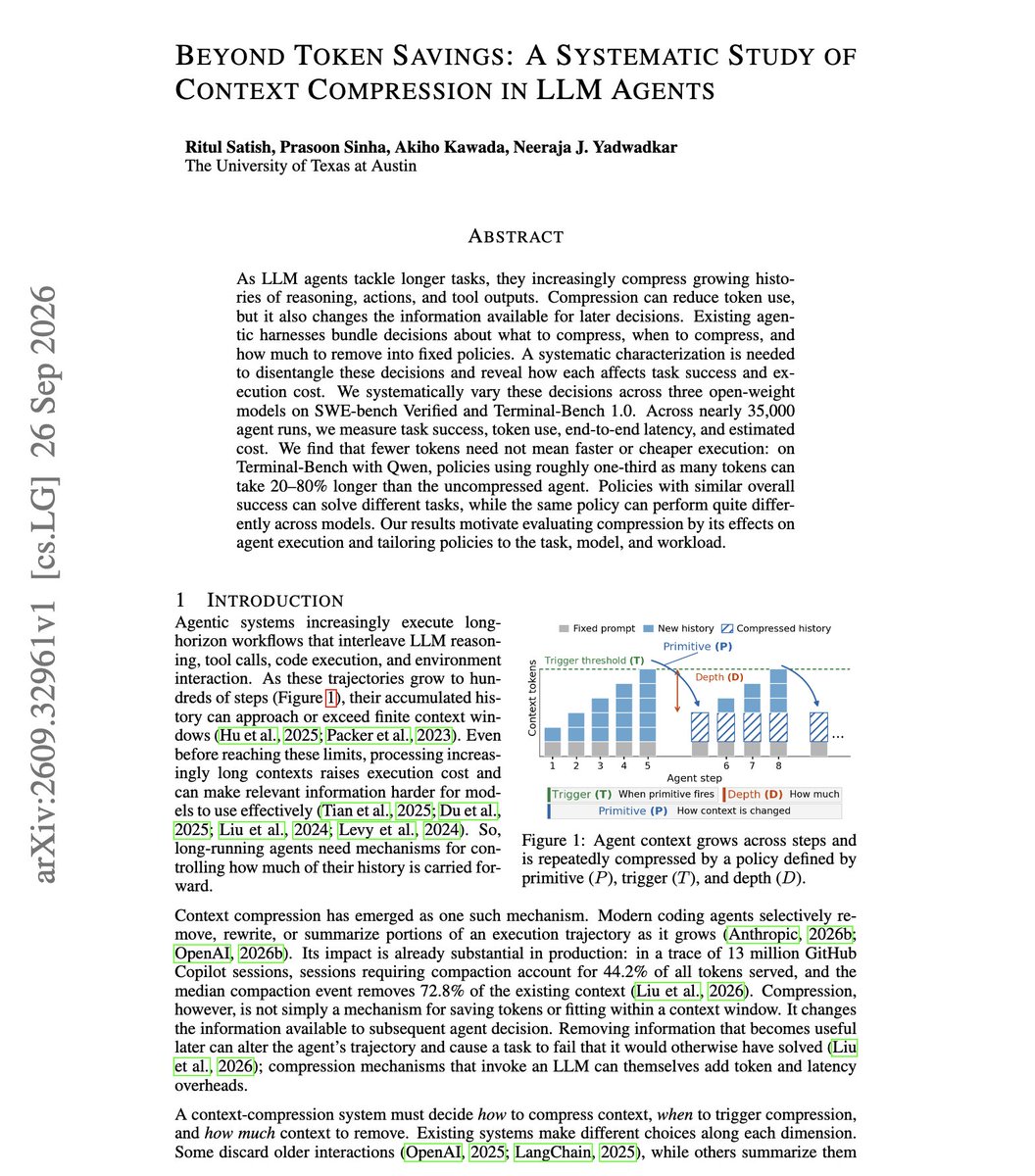
一项来自 UT Austin 的研究在 SWE-bench Verified 和 Terminal-Bench 上运行近 35,000 次 agent 任务,分别考察压缩方式、触发时机和压缩比例三个变量。结果显示,在 Terminal-Bench 搭配 Qwen 时,使用约三分之一 token 的压缩策略可能比保留完整上下文慢 20%–80%;step-triggered 策略每步省 token 最多但模型调用增加 10%–27%,threshold-triggered 策略省 22%–55% 且调用数接近全上下文。同一策略在不同模型上效果差异明显,例如对 Qwen 有效的策略使 Devstral 降至 38.7% 且更慢,因此选型前需按模型实测延迟与成本。
AI推荐理由 该帖转述 UT Austin 关于 LLM Agent 上下文压缩的系统性研究,给出具体实验规模(约 35,000 次 agent 运行,覆盖 SWE-bench Verified 与 Terminal-Bench)、可验证的量化结论(Terminal-Bench + Qwen 下约三分之一 token 的策略反而慢 20%–80%;step-triggered 策略每步省 token 最多但模型调用多 10%–27%;threshold-triggered 省 22%–55% 且调用数接近全上下文;同一策略对 Devstral 表现差异大),并附 arXiv 论文链接,信息密度高、对 Agent 工程选型有直接参考价值。局限在于内容为二手转述,未提供论文原文细节,且部分数字(如 Devstral 38.7%)缺少上下文解释,需以论文为准。
78
浏览 3,775
点赞 52
评论 26
转发 6
正文
Great overview of context compression in LLM Agents
And one interesting, unexpected finding.
If your compaction policy is tuned to cut tokens, it may be making your agent run slower.
Great study from UT Austin on context compression in coding agents.
They ran nearly 35,000 agent runs on SWE-bench Verified and Terminal-Bench and varied three decisions separately. These are how context is compressed, when compression triggers, and how much is removed.
On Terminal-Bench with Qwen, policies that use about a third of the tokens can take 20% to 80% longer than keeping full context.
Step-triggered policies cut the most tokens per step but need 10% to 27% more model calls. Threshold-triggered policies cut tokens by 22% to 55% with call counts close to full context.
Results also differ by model. A policy that works well for Qwen drops Devstral to 38.7% and makes it slower, so measure latency and cost per model before choosing one.
Paper: [arxiv.org/abs/2609.32961](https://arxiv.org/abs/2609.32961)
Chat with Paper: [academy.dair.ai/papers/beyond-…](https://academy.dair.ai/papers/beyond-token-savings-a-systematic-study-of-context-compression-in-llm-agents-2609.32961)